Ohio Radon Risk by County: Highest-Risk Areas & Testing Guide

Why Ohio Homeowners Face Elevated Radon Risk
Ohio sits squarely in one of the most radon-prone regions of the United States. According to the U.S. Environmental Protection Agency (EPA), the majority of Ohio counties are classified as Zone 1, the highest-risk designation, meaning the predicted average indoor radon screening level exceeds 4 picocuries per liter (pCi/L). For perspective, the EPA's action level is 4 pCi/L, and the agency recommends that homeowners consider mitigation even when levels fall in the 2 to 4 pCi/L consider-action zone.
Radon is a colorless, odorless, radioactive gas produced by the natural decay of uranium in soil and rock. In Ohio, the underlying geology — particularly glacial till, limestone, shale, and fractured bedrock — creates ideal conditions for radon to migrate upward and accumulate inside homes. The Ohio Department of Health estimates that roughly 1 in 3 homes tested in the state shows radon levels at or above the EPA action level, a rate that is significantly higher than the national average of about 1 in 15.
Whether you're a long-time Ohio resident or considering a home purchase in the Buckeye State, understanding which counties carry the heaviest radon risk — and what to do about it — is critical for protecting your family's long-term health.

Understanding Ohio's Radon Geology

Before diving into the highest-risk counties, it helps to understand why Ohio is so radon-prone. The state's geology divides roughly into two halves:
- Western and central Ohio is dominated by limestone and dolomite bedrock left behind by ancient seas. These carbonate rocks often contain trace amounts of uranium, and the soil above them — thick glacial till deposited during the last Ice Age — can hold and channel radon gas toward home foundations.
- Eastern and southeastern Ohio features shale, sandstone, and coal-bearing formations from the Appalachian Plateau. Black shales like the Ohio Shale and Sunbury Shale can be uranium-rich and are notorious radon producers.
The combination of permeable soils, fractured bedrock, and homes built on basements or slab foundations creates a near-perfect pathway for radon to enter living spaces. Newer, tightly sealed homes can actually trap radon more effectively than older drafty houses, which is why even brand-new construction in Ohio should be tested.
The Highest Radon-Risk Counties in Ohio
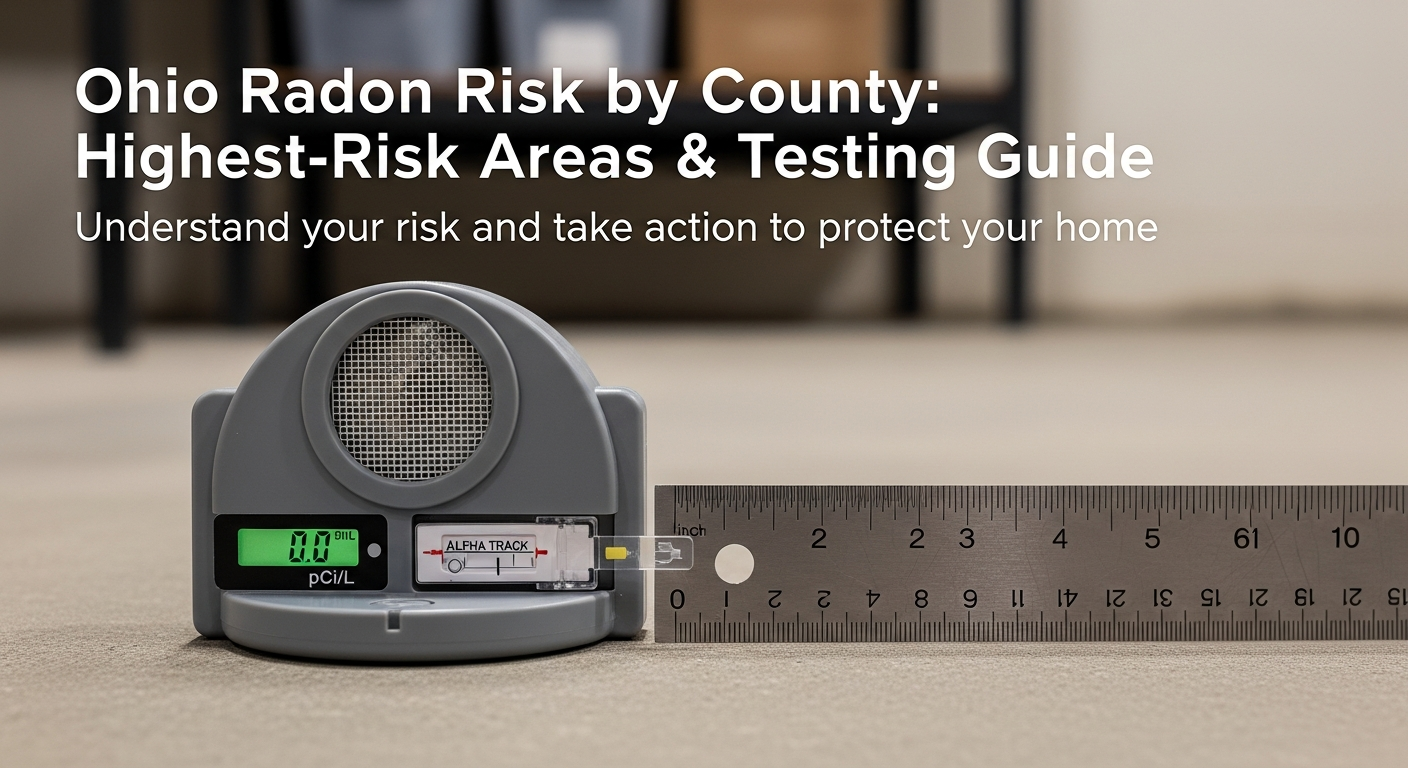
While radon can be found in dangerous concentrations anywhere in Ohio, certain counties consistently report the highest average indoor levels. Based on testing data compiled by the Ohio Department of Health and the EPA, these are among the most radon-affected areas.
1. Hamilton County (Cincinnati Region)
Hamilton County, home to Cincinnati and its suburbs, sits on Ordovician-age limestone and shale that produce substantial radon. The average indoor radon level here often exceeds 8 pCi/L — twice the EPA action level. Homes in older neighborhoods like Hyde Park, Mount Adams, Clifton, and Anderson Township frequently test high, but suburban areas including Mason, West Chester, and Loveland are equally affected.
2. Franklin County (Columbus Region)
The Columbus metropolitan area sits on limestone and dolomite formations that release radon at elevated rates. Franklin County averages around 6 to 7 pCi/L, with neighborhoods such as Bexley, Worthington, Upper Arlington, and Grandview Heights regularly producing test results above 10 pCi/L. The newer suburban developments in Dublin, Hilliard, and New Albany are not exempt — modern construction techniques can actually concentrate radon if no passive mitigation system is built in.
3. Cuyahoga County (Cleveland Region)
Cleveland and its suburbs experience significant radon issues due to underlying shale and glacial till deposits. Cuyahoga County's average indoor radon hovers around 5 to 6 pCi/L, with hot spots in Shaker Heights, Cleveland Heights, Lakewood, Westlake, and Strongsville. Older homes with stone foundations and dirt-floor basements are especially vulnerable.
4. Stark County (Canton Region)
Stark County, including Canton, Massillon, and North Canton, consistently ranks among Ohio's highest-radon counties. Test averages often exceed 7 pCi/L, driven by the area's coal-bearing geology and clay-rich soils that trap radon close to home foundations.
5. Licking County
East of Columbus, Licking County — including Newark, Granville, and Pataskala — sees radon averages above 8 pCi/L in many areas. The county's mix of glacial till and underlying shale creates persistent radon problems in both rural and suburban homes.
6. Greene and Montgomery Counties (Dayton Region)
The Dayton metropolitan area, spanning Montgomery and Greene counties, averages 6 to 8 pCi/L in indoor testing. Suburbs like Kettering, Centerville, Beavercreek, and Oakwood frequently report results well above the action level. The region's limestone bedrock and rich agricultural soils are major contributors.
7. Delaware County
One of Ohio's fastest-growing counties, Delaware County north of Columbus averages around 7 pCi/L in residential testing. Even in brand-new subdivisions in Powell, Lewis Center, and Sunbury, radon is a serious concern — making pre-purchase testing essential for new-construction buyers.
8. Wayne, Holmes, and Ashland Counties
This north-central region, which includes much of Ohio's Amish country, has some of the highest indoor radon averages in the state — often exceeding 9 to 10 pCi/L. Rural homes on private wells and with full basements are especially likely to harbor elevated radon.
9. Knox, Coshocton, and Tuscarawas Counties
Eastern Ohio counties underlain by shale and coal-bearing strata regularly produce test results above 10 pCi/L. Homeowners in Mount Vernon, Coshocton, New Philadelphia, and Dover should treat radon testing as a routine part of home maintenance.
10. Athens, Hocking, and Vinton Counties
Southeastern Ohio's Appalachian foothills sit atop uranium-bearing shales that release significant radon. Athens County, home to Ohio University, sees indoor averages above 7 pCi/L, with some homes testing in the dangerous 15 to 20 pCi/L range.

Why Even "Low-Risk" Counties Still Need Testing
It's tempting to assume that if your county isn't on the highest-risk list, you don't need to worry about radon. That assumption is wrong — and potentially dangerous.
Every single Ohio county has reported homes with radon levels above the EPA's 4 pCi/L action level. Radon concentrations can vary dramatically from house to house, even between neighbors on the same street. Factors that influence individual home radon levels include:
- Foundation type — Basements typically test higher than slab-on-grade or crawl space construction.
- Soil permeability — Sandy or gravelly soils allow radon to migrate more freely than dense clay.
- Foundation cracks and openings — Even hairline cracks, sump pits, floor drains, and utility penetrations provide entry points.
- HVAC operation — Forced-air systems and negative pressure in the lower levels of a home can pull radon inside.
- Weather and season — Radon levels tend to be highest in winter when homes are sealed tight.
The only way to know your home's actual radon level is to test. The EPA, the U.S. Surgeon General, and the Ohio Department of Health all recommend that every home be tested, regardless of geographic risk classification.
Health Risks: Why This Matters
Radon is the second-leading cause of lung cancer in the United States, after smoking — and the leading cause among non-smokers. The EPA attributes approximately 21,000 lung cancer deaths each year to radon exposure. For smokers exposed to elevated radon, the risk multiplies dramatically.
Children may be especially vulnerable because they breathe more rapidly than adults relative to body size, and their developing lungs may be more sensitive to radiation damage. Long-term exposure at levels of 4 pCi/L is roughly equivalent to receiving 200 chest X-rays per year, or smoking eight cigarettes daily.
The good news: radon-induced lung cancer is one of the most preventable cancers, because radon is one of the most easily mitigated indoor air contaminants.
How to Test Your Ohio Home for Radon
Testing is affordable, straightforward, and the essential first step. You have two main options:
Short-Term Tests (2 to 7 days)
Charcoal canister or electret ion chamber tests give you a quick snapshot of radon levels. These are ideal for real estate transactions and for an initial screening. Short-term tests must be conducted under closed-house conditions — windows and doors closed except for normal entry and exit — to produce accurate results.
Long-Term Tests (90+ days)
Alpha-track detectors provide a more accurate picture of year-round average exposure. Because radon levels fluctuate with seasons and weather, long-term tests give a truer reading of your home's radon exposure profile.
Continuous Radon Monitors
For homeowners who want ongoing data, continuous radon monitors provide hourly readings and can detect spikes related to weather or HVAC changes. These are especially useful after mitigation to verify system performance.
For real estate transactions, mortgage approvals, or any situation requiring documentation, hire a NRPP (National Radon Proficiency Program) or NRSB (National Radon Safety Board) certified professional. Certified testers follow strict protocols that ensure the results are valid, defensible, and accepted by lenders, insurers, and buyers.
What to Do If Your Levels Are Elevated
If your test results come back at or above 4 pCi/L, the EPA recommends installing a radon mitigation system. Results between 2 and 4 pCi/L still warrant consideration — there is no truly "safe" level of radon, and reducing exposure is always beneficial.
The most common and effective mitigation method is active soil depressurization (ASD), also called a sub-slab depressurization system. A certified contractor installs a PVC pipe through your foundation, connected to a continuously running fan that vents radon from beneath the slab to outside above the roofline. Properly installed ASD systems typically reduce indoor radon by 90 to 99 percent, often bringing levels well below 2 pCi/L.
Typical Ohio mitigation costs range from $1,200 to $2,500, depending on home size, foundation type, and complexity. The system runs continuously, uses about as much electricity as a 75-watt light bulb, and requires minimal maintenance — just an annual visual check of the manometer gauge.
After installation, retest within 30 days to confirm the system is working, and retest every two years thereafter (or after any major home renovation).
Special Considerations for Ohio Home Buyers
If you're buying a home in Ohio, radon testing should be a non-negotiable part of your due diligence. Ohio requires sellers to disclose known radon information, but disclosure does not substitute for an independent test conducted under your own scope.
When negotiating, you have several options if a test reveals elevated radon:
- Request that the seller install a mitigation system before closing, performed by a licensed Ohio radon contractor.
- Negotiate a credit at closing to cover the cost of post-purchase mitigation.
- Walk away if the inspection contingency in your contract allows it.
For new-construction homes, ask the builder whether a passive radon-resistant new construction (RRNC) system was installed. A passive system includes a vent pipe and gas-permeable layer beneath the slab, designed so that a fan can be easily added if post-construction testing reveals elevated levels. This is becoming standard practice in many high-risk Ohio jurisdictions, but it is not universally required.
Common Misconceptions About Radon in Ohio
Several persistent myths keep Ohio homeowners from taking action. Let's clear them up:
- "My neighbor's house tested low, so mine will too." False. Radon levels can vary dramatically between adjacent homes due to foundation construction, soil conditions, and ventilation differences.
- "My house is new, so it's fine." Newer construction can actually trap radon more effectively because of tight building envelopes. Test regardless of age.
- "I don't have a basement, so I'm safe." Slab-on-grade homes and crawl spaces can develop radon problems too — particularly in Ohio's high-risk soils.
- "Opening windows will fix the problem." Temporary ventilation reduces levels short-term, but it's not a permanent solution and is impractical year-round. Only an engineered mitigation system provides reliable, lasting reduction.
- "Mitigation systems are ugly and expensive." Modern systems are unobtrusive, often routed through closets or garages, and the cost is comparable to a moderate home repair — with potentially life-saving benefits.
Take Action Today
Ohio's geology makes radon a statewide concern, but the highest-risk regions — Cincinnati, Columbus, Cleveland, Canton, Dayton, and the Appalachian counties of eastern and southeastern Ohio — deserve special attention. Whether you live in Hamilton, Franklin, Cuyahoga, Stark, Licking, Delaware, Wayne, or any other Ohio county, the only way to know your radon risk is to test.
If your home tests above 2 pCi/L, consider mitigation. If it tests above 4 pCi/L, the EPA strongly recommends taking action. And remember: radon problems are entirely solvable. A properly designed and installed mitigation system can protect your family for decades at a one-time cost that's a fraction of the value of long-term health.
Ready to schedule a test or get a mitigation quote? Visit FindRadonTesters.com to connect with NRPP and NRSB certified radon professionals serving your Ohio county. Our directory makes it easy to compare local experts, read verified reviews, and book a certified test with confidence — so you can breathe easier knowing exactly what's in the air your family breathes every day.